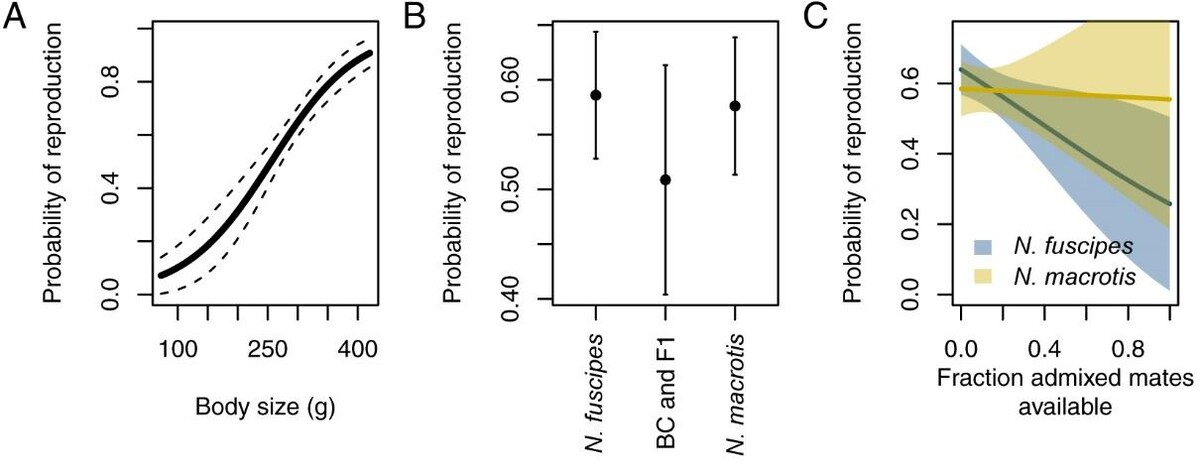
Plots of woodrat probability of reproduction versus body size and fraction of admixed mates available

Asymmetric mate preference and reproductive interference mediate climate-induced changes in mate availability in a small mammal hybrid zone

At the boundary between two woodrat species (Neotoma fuscipes and N. macrotis) in the Sierra Nevada foothills, drought has driven differential survival between the species and their hybrids, changing who is available to mate with whom. Using six years of field-measured parentage data, we show that as conspecific mates became scarcer, hybridization rates increased — but not symmetrically. Reproductive success was skewed between the parental lineages, F1 hybrid males had near-zero reproductive success, and nearly all surviving hybrids had one purebred parent, pointing to partial genomic incompatibility between the two species. ...

August 8, 2024 · Marjorie D. Matocq, Elizabeth A. Hunter, Peter J. Murphy, Casey L. Adkins, Kevin T. Shoemaker

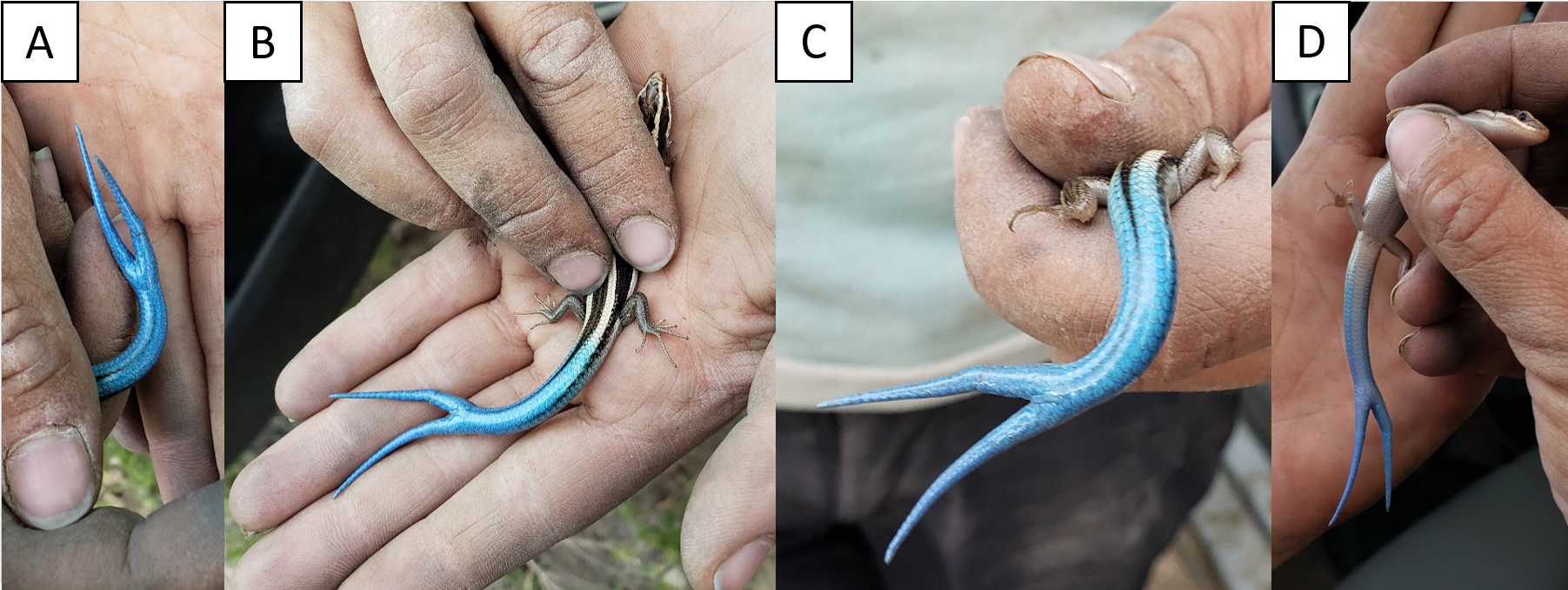
Tail bifurcation in Plestiodon skiltonianus

As part of our field research, members of the A.P.E. lab occasionally stumble on a novel observation worthy of a published ’natural history note’. Here, we note the observation of tail bifurcation in the western skink, Plestiodon skiltonianus: This is the first publication for UNR undergraduate Chasey Danser (pictured below doing field research)- congratulations Chasey!! (Photo credit: Danielle C. Miles) Miles, D.C., Danser, C., and K.T. Shoemaker. 2020. Tail bifurcation in Plestiodon skiltonianus. Herpetology Notes. https://www.biotaxa.org/hn/article/viewFile/57502/60850

May 21, 2020 · K.T. Shoemaker and D.C. Miles

Understanding the conservation status and habitat needs of the pygmy rabbit

The A.P.E. lab is part of a larger team at UNR investigating the population genetics and demography of the pygmy rabbit (Brachylagus idahoensis) in the Great Basin. To stay up to date on the pygmy rabbit project, led by APE lab PhD student Miranda Crowell, check out her website UNR collaborators: Marjorie Matocq Peter Weisberg and Tom Dilts Jim Sedinger Other collaborators: Sheldon and Hart National Wildlife Refuges, Nevada Department of Wildlife, Great Basin Landscape Conservation Cooperative, Greater Hart-Sheldon Fund Publications: Crowell, M.M., Matocq, M.D., Dilts, T., Shoemaker, K.T. In prep. Turnover in pygmy rabbit (Brachylagus idahoensis) site and burrow activity in the Great Basin. Conservation Biology. ...

January 17, 2020 · Kevin Shoemaker

Understanding the broader ecological impacts of PJ removal

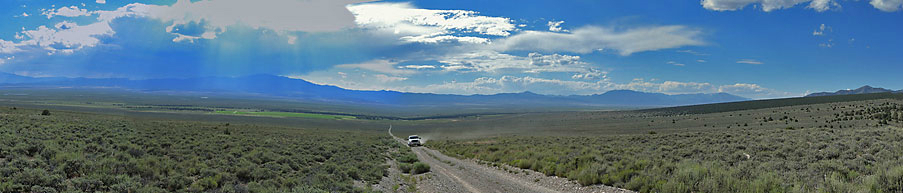
Investigating the broad ecological impacts of Pinyon and Juniper removal in Nevada Thousands of acres of pinyon and juniper woodlands (PJ) will be removed over the next four years to support targeted wildlife populations, notably Greater sage-grouse. We are investigating the effects of PJ removal on insect communities and the bats and reptile species that rely upon them using a rigorous experimental design. Insects can serve as useful indicators of natural disturbances, provide critical pollination services, and represent a major wildlife food resource for many species, including an impressive diversity of bats and reptiles. Little is known about habitat use and disturbance tolerance for bats and reptiles in the Great Basin. For example, some bat species may benefit from tree removal (e.g., cleared areas may improve foraging or success), while other species may be negatively impacted by tree removal (e.g, loss of roosting sites). We are establishing a set of fixed transects, each spanning a gradient from sagebrush steppe to PJ woodland and monitored 3 to 4 times annually. Transects will be established in four project areas distributed widely across the Great Basin- including the Sheldon-Hart refuges and the Ely region (near Great Basin National Park). ...

October 12, 2016 · Kevin Shoemaker and Danielle Miles